

- BYAlina Harold - 20 Nov, 2025
- 8 Mins Read
- 6 views



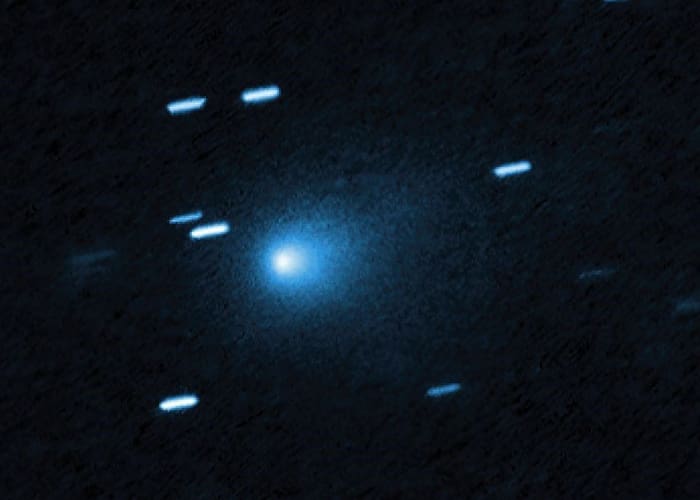
NASA scientists are preparing to release extraordinary new imagery and scientific data this week that captures the first detailed observations of interstellar comet 3I/ATLAS, marking only the third time in astronomical history that humanity has witnessed a visitor from beyond our Milky Way galaxy entering our solar system. This unprecedented cosmic event has triggered an international scientific mobilization, with telescopes across Earth and spacecraft throughout our solar system turning their instruments toward this enigmatic celestial traveler that originated from the depths of interstellar space. The comet's arrival represents a once-in-a-generation opportunity for researchers to study the chemical composition and physical characteristics of matter that formed in an entirely different star system, potentially billions of years ago and light-years away from our own cosmic neighborhood.
The significance of 3I/ATLAS extends far beyond its spectacular appearance in our night sky, as this interstellar interloper carries within its icy nucleus the preserved chemical fingerprints of its distant birthplace among alien stars. Unlike comets that formed alongside our own solar system 4.6 billion years ago, this visitor condensed from the interstellar medium in a completely different stellar environment, possibly around a star with vastly different characteristics from our Sun. Scientists are particularly excited because studying this comet's composition will provide the first direct comparison between the building blocks of our solar system and those of another star system, potentially revealing whether our cosmic neighborhood is chemically typical or uniquely suited for life as we know it.
The Hubble Space Telescope has already begun capturing unprecedented detail of the comet's nucleus and its developing coma, the glowing envelope of gas and dust that forms as the Sun's heat begins to vaporize the comet's frozen surface. Initial observations reveal that 3I/ATLAS possesses a remarkably bright nucleus surrounded by a complex tail structure that stretches millions of kilometers across space, creating a cosmic spectacle visible through modest telescopes under dark skies. The comet's trajectory suggests it entered our solar system from the direction of the constellation Lyra, traveling at an incredible speed of over 100,000 miles per hour, fast enough to escape the Sun's gravitational pull and continue its eternal journey through interstellar space after its brief encounter with our solar system.
Professional astronomers and amateur skywatchers alike have been tracking this interstellar visitor since its discovery, with observations revealing unusual chemical signatures that distinguish it from native solar system comets. Early spectroscopic analysis has detected elevated levels of carbon monoxide and cyanide gas compared to typical comets, suggesting the comet formed in a stellar environment with different chemical abundances than our own Sun's birthplace. The comet's surface also appears to contain complex organic molecules, the carbon-based compounds that serve as the fundamental building blocks for life, raising intriguing questions about whether similar chemical processes occur throughout our galaxy.
The scientific community's response to 3I/ATLAS's arrival has been swift and comprehensive, with NASA coordinating observations across multiple space-based observatories and ground-based telescope networks around the world. The agency's planetary defense coordination office has been working closely with international partners to ensure continuous monitoring of the comet's trajectory, while simultaneously gathering data that could help scientists identify future interstellar visitors more quickly. This coordinated approach represents a new era in astronomy, where the detection and study of interstellar objects has become a priority for understanding our place in the cosmic ecosystem.
Historical context makes this discovery even more remarkable, as humanity has only confirmed two previous interstellar visitors: the asteroid 'Oumuamua in 2017 and comet Borisov in 2019. The fact that we're now detecting these objects with increasing frequency suggests that either our detection capabilities have dramatically improved or that our solar system might be passing through a region of space with a higher concentration of interstellar debris. Each of these visitors has been fundamentally different from the others, with 'Oumuamua appearing as a rocky, asteroid-like object and Borisov displaying typical cometary characteristics, while 3I/ATLAS shows unique properties that don't fit neatly into either category.
The technical challenges involved in studying 3I/ATLAS have pushed astronomers to develop innovative observation techniques that maximize the scientific return from this brief cosmic encounter. Because the comet will only remain observable for a few months before continuing its journey back into interstellar space, every moment of telescope time has become precious. Researchers are employing adaptive optics systems to compensate for atmospheric distortion, specialized filters to isolate specific chemical signatures, and rapid-response observation protocols that can quickly redirect telescopes when significant changes occur in the comet's behavior.
The implications of studying interstellar objects extend far beyond pure scientific curiosity, as these visitors provide crucial information about planetary formation processes throughout our galaxy. By comparing 3I/ATLAS's composition with comets that formed in our own solar system, scientists can determine whether the chemical processes that created our cosmic neighborhood are typical or exceptional. This information is vital for understanding how common Earth-like planets might be throughout the galaxy and whether the conditions necessary for life as we know them are widespread or rare.
Leading planetary scientists have expressed extraordinary enthusiasm about the data already collected from 3I/ATLAS, with some comparing its significance to the Rosetta mission's study of comet 67P/Churyumov-Gerasimenko. Dr. Karen Meech, an astronomer at the University of Hawaii's Institute for Astronomy who has studied previous interstellar objects, notes that 3I/ATLAS appears to have a higher concentration of volatile compounds than typical solar system comets, suggesting it formed in a much colder environment. This finding supports theories that objects like 3I/ATLAS may have originated in the outer regions of a distant star system before being ejected by gravitational interactions with massive planets.
The comet's trajectory has been calculated with extreme precision, allowing astronomers to project its past and future path through interstellar space. Computer simulations suggest that 3I/ATLAS likely began its journey millions of years ago when gravitational perturbations from a passing star or massive planet ejected it from its original solar system. Since then, it has been traveling through the darkness between stars, preserving within its frozen interior the chemical conditions of its birthplace until our Sun's heat began releasing these ancient gases for our telescopes to analyze.
Public interest in 3I/ATLAS has surged as amateur astronomers around the world share their own observations and images of this historic visitor, creating an unprecedented global citizen science effort. Social media platforms have been flooded with stunning photographs showing the comet's distinctive greenish glow caused by the presence of diatomic carbon molecules, while online astronomy communities have coordinated observation campaigns to ensure continuous monitoring. This grassroots involvement has supplemented professional observations and demonstrated how modern technology enables ordinary people to contribute meaningfully to cutting-edge scientific discovery.
The technological advances that made 3I/ATLAS's discovery and study possible represent a revolution in astronomical observation techniques, with new survey telescopes like the Pan-STARRS facility in Hawaii scanning the sky every night for moving objects. These automated systems can detect incredibly faint objects and determine whether they're bound to our solar system within hours of discovery, a process that previously required weeks or months of careful observation. The success of these surveys suggests that we'll likely detect many more interstellar visitors in the coming years, potentially revealing whether objects like 3I/ATLAS are common or rare in the cosmic scheme.
Future missions to study interstellar objects are already being planned, with some scientists proposing rapid-response spacecraft that could launch within months of an object's discovery to intercept it before it leaves our solar system. These ambitious concepts would require unprecedented international cooperation and technological innovation, but the scientific rewards would be immense. A spacecraft that could analyze an interstellar object up close would provide far more detailed information than telescopes alone, potentially revealing the exact stellar nursery where the object formed and the specific conditions that existed there.
The study of 3I/ATLAS has also sparked renewed interest in developing better methods for detecting and tracking potentially hazardous objects from interstellar space, as these visitors travel so fast they could approach Earth with little warning. While 3I/ATLAS poses no threat to our planet, its discovery has highlighted how vulnerable we might be to future interstellar objects on collision courses with Earth. This concern has prompted calls for improved space-based detection systems that could spot these fast-moving visitors much earlier than current ground-based telescopes allow.
As 3I/ATLAS continues its journey through our solar system, scientists are racing against time to gather as much data as possible before it disappears forever into interstellar space. Each new image and spectrum provides fresh insights into this visitor's composition and history, while also teaching us more about the diversity of planetary systems throughout our galaxy. The comet's passage represents a unique opportunity to study the raw materials of planet formation in another star system, providing clues about how common or unusual our own solar system's chemistry might be in the cosmic context.
The cultural impact of 3I/ATLAS's arrival has extended beyond scientific circles, inspiring artists, writers, and musicians to create works that reflect on our place in the universe and the wonder of receiving visitors from distant star systems. This interstellar comet has reminded humanity that we live in a dynamic, interconnected cosmos where material from one star system can travel to another, potentially carrying the seeds of life between worlds. The comet's brief visit has reignited public fascination with space exploration and the possibility that we might one day visit other star systems ourselves, continuing the eternal cycle of cosmic migration that brought 3I/ATLAS to our doorstep.
Categories:



Historical Research

Please log in to leave a comment.
Comments 0
Loading comments...
No comments yet. Be the first to comment!